CONTACT
Phone: 201-369-4340
830 Bergen Ave
Suite 6B
Jersey City, NJ 07306
Transportation projects
County Avenue Concept Development
Hudson County is undertaking a pavement improvement project along County Avenue (County Road 653), a vital north-south corridor in Secaucus. This 1.6-mile stretch, from Milepost 1.33 to 2.93, connects Interstate Route 95 with Secaucus and Jersey City, serving as a key link for commuters, freight, and public transit. With its mix of roadway configurations and heavy multimodal traffic, County Avenue plays an essential role in regional mobility and economic activity.
Hudson County is using Congressional funding for an upgrade of County Avenue. These improvements will enhance roadway conditions, support freight movement, and improve accessibility for all users, including pedestrians and transit riders. Planned upgrades include milling and paving the entire roadway, installing or reconstructing drainage systems, adding new curbing and ADA-compliant ramps, and replacing striping and guide rails. Safety enhancements such as rumble strips at curves and centerline rumble strips will help reduce truck speeds. Additionally, traffic signals will be upgraded to meet MUTCD standards, ensuring safer and more efficient travel along this critical corridor.
Click here or the Public Meeting Presentation.
Congestion Mitigation Air Quality (CMAQ) Program

JFK Boulevard Traffic Signal Optimization- St. Paul’s Avenue – Clinton Avenue
JFK Boulevard Traffic Signal Optimization- Armstrong Avenue – Clinton Avenue (Part B) – County of Hudson ($240,000)
Click Here to view/download: Congestion Mitigation Air Quality Program
One of Hudson County’s goals is to optimize County-owned traffic signals with ITS technology. Hudson County was recently awarded funds from a NJTPA’s Congestion Mitigation and Air Quality (CMAQ) grant for signal optimization on JFK Blvd. between Clinton Avenue and Armstrong Avenue in Jersey City, NJ -obligate three (3) miles of its roadway to optimize traffic signals. The benefits would include reductions in air pollutants and reduced congestion spanning from Journal Square towards the Jersey City/City of Bayonne border.
By programming each signal with a predetermined timing offset, a ‘green wave’ can be achieved, allowing motorists to progress along the corridor at the desired speed. This technique can also be used to prioritize bicycles and pedestrians by changing the offset to align with typical cycling and walking speeds. Synchronizing signals can be most effective when combined with advisory signage that tells drivers what speed the signals are set for.
Hudson County’s ITS proposal compliments multiple regional and statewide planning initiatives. There are many ongoing discussions with regional and national stakeholders to minimize safety and environmental risks exacerbated along high-traffic corridors of Jersey City catalyzed by congestion overflowing from state roads and interstate highways.
NJDOT – Transportation Alternatives Program (TAP) Grant
The goal of the Transportation Alternatives Program is to provide federal funds for
community-based “non-traditional” projects designed to strengthen the cultural, aesthetic, and environmental aspects of the nation’s intermodal system.
The Office of the County Engineer intends to use the grant’s funds to preserve the Morris Canal footprint within the park, and implement a list of improvements, including new pedestrian walkway surface treatment, interpretive signage throughout the park, bike racks, a rain garden, and a pavilion.
Click here to view/download: NJDOT TAP Grant
The Gateway Program
The gateway Program would increase resiliency and capacity along a 10-mile stretch of the NEC between Newark, New Jersey and Pennsylvania Station in New York City (PSNY).
This section of the NEC handles approximately 450 trains per day and over 200,000 daily Amtrak and NJ TRANSIT passenger trips, and directly serves PSNY – the busiest rail station in America. This busy, 10-mile stretch of the NEC includes the North River Tunnel under the Hudson River, which has deteriorated due to age, intensive use, and damage sustained from saltwater exposure during Superstorm Sandy in 2012.
Click here to view/download: The Gateway Program
The Gateway Program is currently underway, and includes two active projects:
The Portal North Bridge Project
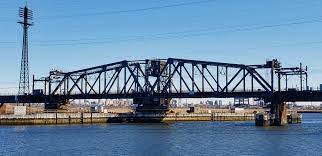
The Portal North Bridge Project will replace the current, functionally obsolete Portal Bridge – a century-old two-track, railroad swing bridge spanning the Hackensack River between Secaucus and Kearny, New Jersey – with a new, high-level, two-track fixed span. The new bridge will increase rail transit capacity by an estimated 11%, and significantly improve service reliability by replacing the movable span, which interrupts operations and is prone to mechanical failures, and is the current cause of frequent delays. The Project is fully designed and permitted. Early construction work began in Fall 2017.
The Hudson Tunnel Project

The Hudson Tunnel Project is currently in the environmental review process and includes two components: the construction of a new two-track Hudson River rail tunnel from New Jersey to Manhattan that will directly serve PSNY; and the rehabilitation of the century-old existing North River Tunnel, which incurred serious damage during Superstorm Sandy in 2012. The North River Tunnel is a critical link in the region’s trans-Hudson commuting system, and the Hudson Tunnel Project is urgently needed. A closure of just one tube could reduce capacity by as much as 75%, and force tens of thousands of commuters and travelers into other modes of travel, pushing them onto already congested bridges, tunnels, and streets in both states. The resulting congestion would lead to massive degradation of air quality throughout the region, with the movement of people and goods to and from the nation’s largest regional economy becoming severely constrained.
The Essex-Hudson Greenway
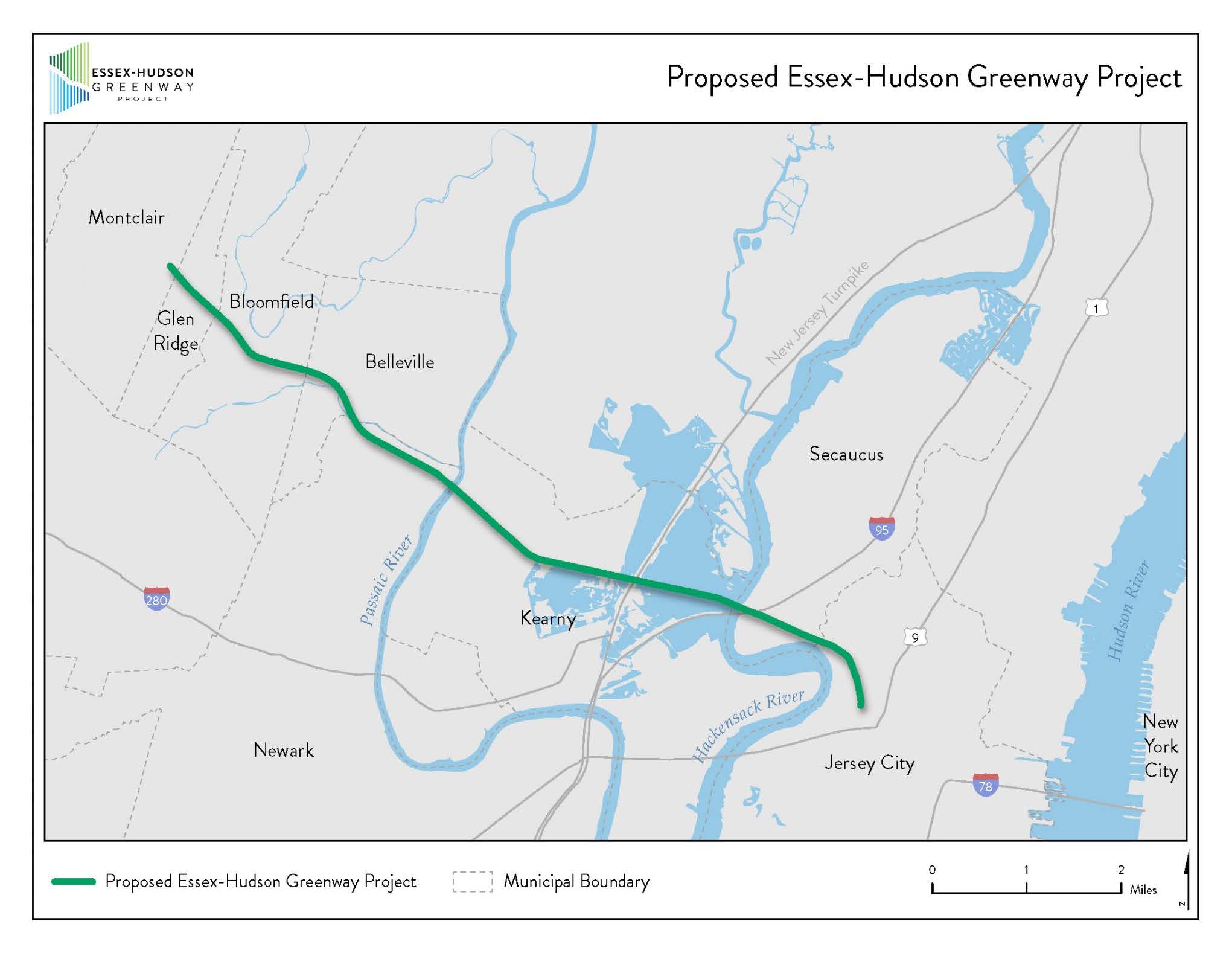
The proposed Essex-Hudson Greenway Project would offer a nearly nine-mile long, multi-use trail corridor following a converted rail line, creating more than 135 acres of new green space when completed. The greenway sets the stage for the creation of a nearly nine-mile transformational linear park that will provide new recreation opportunities for walkers, bikers, birders, and other nature lovers while improving transportation options for area residents. For additional information on this project, please visit https://dep.nj.gov/greenway/
Click here to view/download the plan: The Essex-Hudson Greenway
An enlarged image of the greenway map can be found here.